
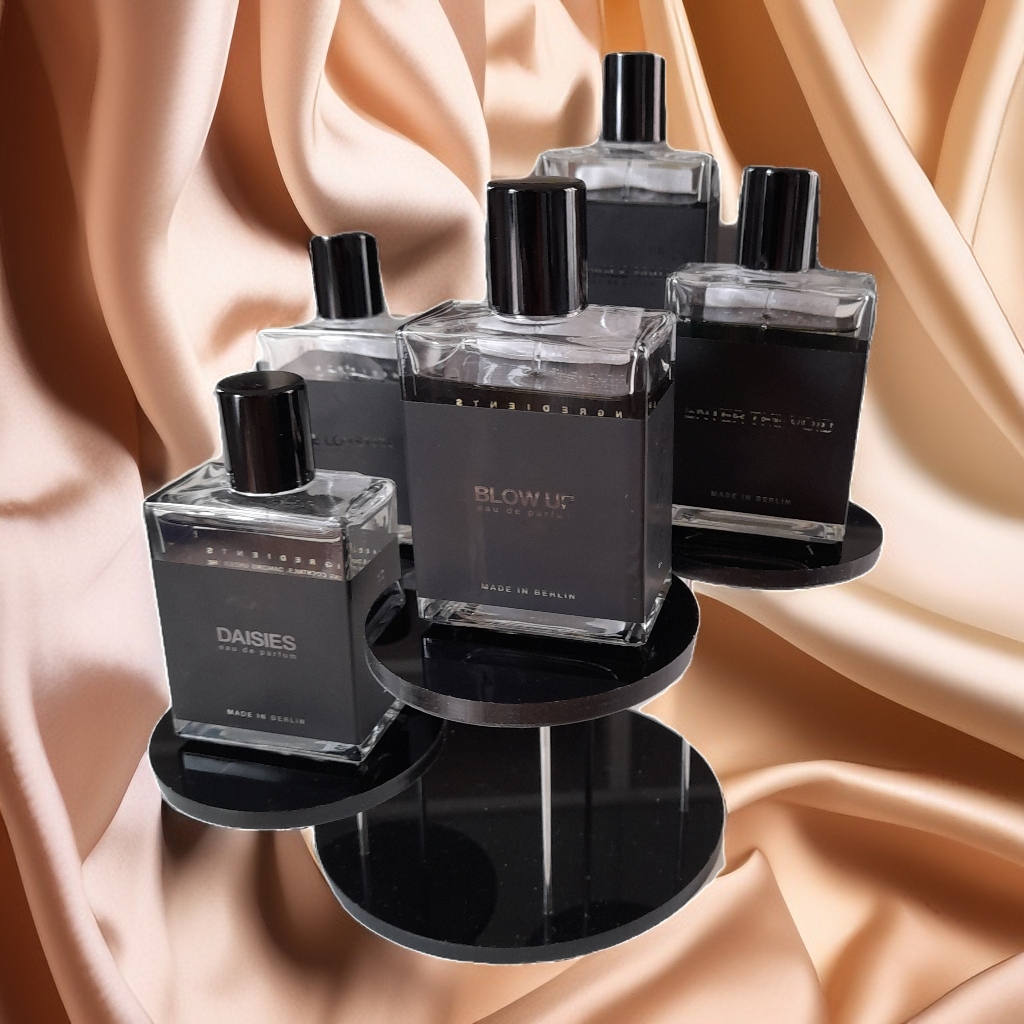
How many times have you bought a fragrance because you were captivated by the scent you accidentally smelled in a perfumery, only to realize, upon wearing it, that it's too faint? Or, conversely, that it's a bit too strong in the summer?
Despite what you may have taken for granted all these years, Not all of the liquid contained in a “perfume” is actually perfume , but only a percentage ranging from 1 to 30%.
In fact, each fragrance is characterised not only by its own smell, or by the olfactory family to which it belongs, but also by the percentage of raw materials contained inside the bottle.
Based on this percentage and these differences, which inevitably determine the intensity or persistence of a fragrance, we therefore speak of Eau de Cologne, Eau de Toilette, Eau de Parfum and Extrait de Parfum.
TYPES AND CONCENTRATIONS
You've probably already realized how important it is to understand the differences between the different types of fragrances we admire on the shelves of our favorite boutiques, well before purchasing.
Here's why We decided to explain to you when it is better to prefer one concentration over another , why choose it and what to expect. But let's start by listing the four main types of perfume, citing the authoritative Academy of Perfume :
- Eau de Cologne (EDC) contains 3 to 5% raw materials
- Eau de Toilette (EDT) are composed of 12 to 15% pure perfume
- Eau de Parfum (EDP) have a percentage of essential oils between 15 and 20%
- Extraits, on the other hand, contain approximately 25 to 30% of perfumed notes.
Which one to choose? On paper, there is no better option than another, because choosing a perfume It's always subjective. But when choosing, it's best to keep in mind that:
- Depending on the climate and seasonal temperatures, the performance of the perfume on your skin can vary . If it is too hot, for example, naturally intense fragrances (composed for example of Oud, Amber or Patchouli) can clash;
- The pH of your skin It can completely inhibit or, conversely, enhance the performance of the type of fragrance worn . Oily skin is an excellent base for applying perfume and allowing it to linger. Dry or acidic skin, on the other hand, facilitates the evaporation of the perfume. It follows, for example, that an Eau de Cologne, however light, may still linger longer than usual on certain skin types;
- The ability to perceive odors varies from person to person . Some people have a more trained sense of smell, while others are less accustomed to them. Smell is a sense and, as such, is affected by temporary or permanent changes caused by various factors, such as stress, medication, flu, pregnancy, smoking, etc. This is to say that if you feel like you're not smelling enough of a particular scent, that doesn't mean that the people around you feel the same way;
- Depending on the olfactory family it belongs to, the perception one has of a perfume can change . It is well known, for example, that woody or oriental notes can accentuate the persistence of a fragrance, making it seem more concentrated, and therefore persistent, than it would actually be if the notes were, for example, floral. A naturally full-bodied 15% Oud will always be much stronger than a light Rose, used in the same percentage;
- The desired outcome for that particular moment should influence the choice of perfume. Do you want to impress with a long-lasting scent that lasts all evening? Or do you need something light and fresh to spray after your shower? Different circumstances and needs often require different choices.
If therefore scented accords and olfactory pyramids they do not change in substance, leaving the interplay between top, heart and base notes unchanged, what really changes is the performance of the type of perfume over time.
Once you fully discover the many possibilities offered by perfume types, you will certainly end up buying not just one, but you will discover how the same fragrance can be purchased in multiple variations and types, to be worn at different times.
DIFFERENCES BETWEEN EAU DE COLOGNE AND EAU DE TOILETTE
Due to the limited presence of raw materials, There are no significant differences between Eau de Cologne and Eau de Toilette . In both cases, we're talking about fresh, light essences, excellent for use during the warmer periods of the year.
Choose an eau de cologne Or an Eau de Toilette if you're looking for a light fragrance for summer evenings. Perfect for spraying after a shower, on damp skin, for a refreshing and regenerating effect, or to complete your beauty routine.
While citrus, floral, or marine EDCs and EDTs are perfect for balanced or oily skin, they may be imperceptible on those with excessively dry or acidic skin.
DIFFERENCES BETWEEN EAU DE COLOGNE, EAU DE TOILETTE AND EAU DE PARFUM
Compared to colognes or Eau de Toilette, Eau de Parfums stand out thanks to their two or three times higher percentage of essential oils . This characteristic makes EDPs the best choice for those who want a more persistent, long-lasting fragrance.
Unlike colognes, in which the olfactory pyramid is only partially perceptible, with the Eau de Parfum it is possible to appreciate as many nuances as there are olfactory notes that make up the essence, a factor which often makes them preferred by those who are true enthusiasts of artistic or niche perfumery.
So, if you're looking for a light fragrance that lingers on your skin for a short time, perhaps because you like to change fragrances depending on the occasion, or because it's summer, an Eau de Toilette or Eau de Cologne might be the best choice. If, on the other hand, the idea of leaving a trail intrigues you, an Eau de Parfum is certainly a must.
Again, dry skin or skin with an acidic pH risks nullifying the lasting effect of an EDP. This is why it can sometimes be helpful to use an unscented moisturizer as a base.
DIFFERENCES BETWEEN EAU DE PARFUM AND EXTRAIT
Unlike Eau de Parfum, the Extract They are perfumes that contain a huge percentage of raw materials and, for this very reason, often feel oily to the touch.
Much less widespread and little known than classic EDPs, Extrait de Parfum are usually sold in smaller bottles, precisely because they are more precious, in terms of content and packaging, as well as in price.
Buying a perfume extract means wearing a consistent and strong fragrance on your skin, much more so than an EDP, which is not necessarily a positive thing, but can actually have negative effects, such as excessive oiliness on the skin.
Several years ago, extracts were sold with convenient manual dispensers, allowing the perfume to be applied carefully and sparingly. Today, however, extracts are almost always sold in classic spray atomizers, which, with such a large quantity of raw materials, risk shortening the life of a bottle of perfume.